You Can't Fix Chaos by Doing More
The simplest operating system I know for building a business and a life.
A founder told me recently that he was drowning.
Three new AI tools implemented this week. Two podcasts at double speed before lunch. A content creation course half-finished. A sales pitch deck rewritten for the fourth time.
"I'm busy all day," he said. "No time to sell. No time to think."
I've heard some version of that sentence from founders more times than I can count.
If you open your laptop, scroll the feed, and get stuck.
If every new AI release makes you feel behind instead of excited.
If you finish the week exhausted but can't name one thing you actually shipped.
That's not just a productivity problem. That's chaos.
Most entrepreneurs are living in it.
The instinct is to fix chaos with more hustle. More tools. More content. More plans. More hours.
It might work for a moment, but you can't fix chaos by doing more. More inputs into a messy system just make a bigger mess.
What actually works is fewer things, done properly, for a long time.
I wrote a short version of this on LinkedIn in September. It landed well on Instagram too. So here's the long version.
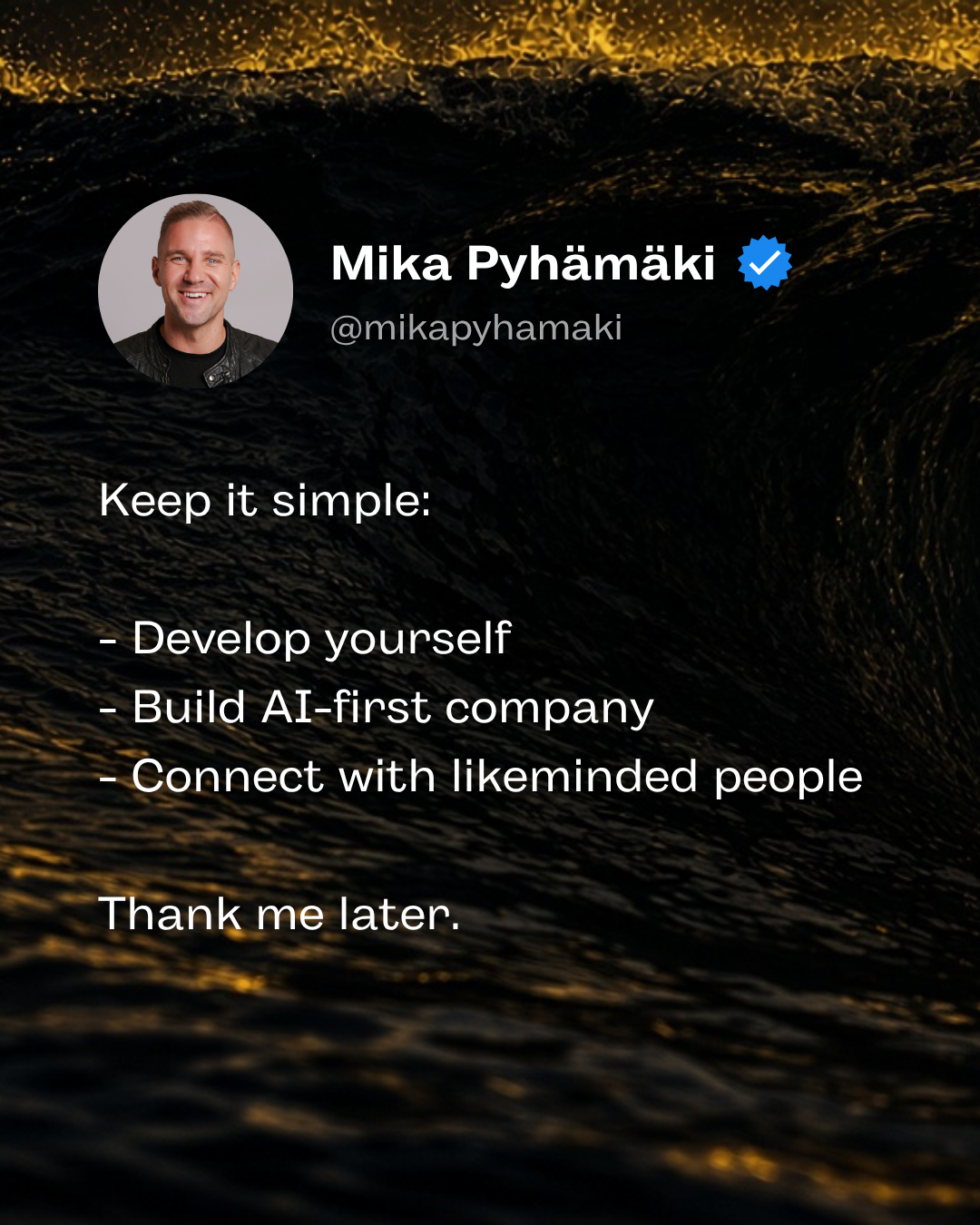
I promise to keep it simple. Three things.
⚡️ Chapter 1: Develop yourself
Investing in yourself is the best investment you can make.
It's the only asset you'll own for your entire career. Every company you build, every deal you close, every team you lead runs through it.
And it compounds. Quietly at first. Then faster and faster.
Most founders know this in theory. Very few act on it.
They treat their health like a reward for later. After the funding round. After the big client. After the launch.
Later never comes. The business always has another reason.
So here's the truth.
Your physical and mental health are not a side project. They are the foundation of a great life and a great business.
When the body breaks, the business usually breaks too.
Why I went back to school at 39
I train at the gym about 150 times a year.
Sleep. Train. Eat. Work. Repeat. That rhythm is the backbone of my life.
In August I also started an intensive personal trainer course.
People asked why. I already train. I already run a business. Why add a certification?
Because I wanted to understand the complete human performance system instead of following random tactics.
Right now I'm working with my first pilot customers. I'll finish the programme before the end of the year.
And the surprising part is how familiar it all feels.
It's the same job
Coaching someone in the gym and coaching a founder are the same job.
You're not giving them information. They already know what to do.
Everyone knows they should sleep more, train more and eat better. Every founder knows they should focus, sell more and stop doing everything themselves.
Knowing was never the problem.
The work happens in four steps.
1. Face the brutal truth
First, you help them understand where they are right now. Not where they wish they were. Not where they were five years ago.
Where they actually are.
In the gym, that's the honest starting point. How you move, how you recover, what you actually do in a normal week.
In business, it's the same. Real revenue. Real pipeline. Real hours spent on things that matter versus things that just feel busy.
This step is uncomfortable. That's why most people avoid it and never track it.
But you can't plan a route if you lie about the starting point.
2. Clarify the goals worth pursuing
Second, you clarify the goals that are actually worth pursuing.
Not every goal is.
Plenty of founders chase targets they didn't even set themselves. A number someone else achieved. A lifestyle that looks good on social media. A valuation that impresses at dinner parties.
A goal worth pursuing is one you'd still want after the excitement fades. One that fits the life you actually want to live.
Fewer goals. Clearer ones. Written down.
That clarity is what drives better performance.
3. Build a strategy that delivers
Third, you build a strategy that delivers the results.
A goal without a strategy is a wish.
Strategy is the bridge between where you are and where you want to be. What you'll do, in what order, and just as importantly, what you won't do.
In gym training, that's the programme. In business, it's the plan. Which customers, which offer, which channel, which quarter.
Good strategy is simple. It removes options. That's the point.
4. Build habits and systems that hold
Finally, you build the habits and systems that hold when motivation disappears.
Most people start here. They want the routine before they've faced the truth, picked the goal or made the plan.
Motivation is a feeling. It shows up when things are easy and leaves when they get hard.
Habits are a system. They show up anyway.
A few principles I keep coming back to:
Start smaller than feels useful. Three short sessions a week you'll actually do beat a perfect plan you abandon in February.
Protect the time first. If training goes in the calendar after meetings, it disappears. Put it in first and build the day around it.
Consistency before intensity. Nobody gets strong from one heroic week. You get strong from progressive overload.
Measure the habit, not just the result. Did you show up? That's the number that predicts everything else.
Every one of those rules works for a business too. Swap "training session" for "sales call" or "writing block" and read it again.
That's the work I'm doing now. For my customers, and for myself.
The founder dividend
The version of me that trains is a better founder than the version that doesn't.
Clearer head. Better decisions. More patience in hard conversations. More energy in the evening, when the work that sets you apart often happens.
That's the return on investing in yourself. It doesn't show up on a spreadsheet. It shows up in every decision you make.
Keep moving.
⚡️ Chapter 2: Build an AI-first company
AI is the greatest revolution of our time. And a massive opportunity for us entrepreneurs.
I don't say that lightly. I've spent over 12 years in the technology industry. I've seen plenty of hype cycles come and go.
This one is different.
It collapses the cost of building things.
Writing, research, analysis, design, code. Work that used to need a team, a budget and six months now needs one focused person and a few good days.
One person can now outcompete a team of ten.
It changes what's worth building. And it changes who will win.
Founder-led growth is the unlock
Here's where I think most founders are looking in the wrong place.
They use AI to do the same old work slightly faster. Faster code. Faster emails.
The bigger opportunity is founder-led growth.
Your own personal brand. Your own media.
Your core identity, shared with the world.
People buy from people they trust. Especially when the deal feels important and the risk is real.
A buyer who has read your thinking and watched your videos for six months walks into the first meeting already halfway to yes.
Ten years ago, building that kind of media presence took a production team, specialist skills and a budget most founders didn't have.
Today you can run it with AI agents as your production crew.
That's exactly why I'm building Focus Forward as an AI-first media company. Podcast, newsletter and live events. Run lean, build trust with the audience, and let AI do the heavy lifting behind the scenes.
Build the context, not another frankenstack
The marketing channels are changing fast. So are the apps.
Google Search, in its original form, is dead.
Every month there's a new platform you must be on. A new tool that will change everything. A new model that beats the last one.
If you chase all of it, you're back in chaos.
So I focus on what doesn't change. The core context.
I'm building mine mainly with Claude. I also use Gemini and Grok, and I'm following Meta closely. All of them are crushing it right now.
But you don't control the frontier models. You control your own core context.
Who I serve. What I believe. How I write. What I sell and why. The problems my customers bring me. The use cases that actually save me time.
That context is the real asset.
Tools will keep changing. Your context stays with you. Plug it into the next model and you're productive on day one.
Where to start
If you're a founder and this feels overwhelming, start here:
Write your context down. One document. Your customer, your offer, your point of view, your voice. This becomes the brief every AI tool works from. You can store it in Google Drive or locally on your computer.
Pick one channel you own. A newsletter, a podcast, a YouTube channel. Rented platforms are great for reach, but you want an audience you can always reach directly.
Find three repeatable use cases. Not fifty experiments. Three things you do every week that AI can take off your plate. Repurposing content. Researching prospects. Preparing meetings. Then track the progress.
Publish on a rhythm. Weekly or bi-weekly. The compounding effect comes from consistency, not from any single post.
Selling time vs building value
And here's the part most people miss.
Anyone can sell time. Very few learn to build value.
That's the difference between having a job and growing a business.
Consultants, freelancers, agencies. Selling hours is a ceiling. You can only work so many of them.
I know this from experience. Consulting pays well, but it never scales past your own calendar.
AI doesn't lift that ceiling. It lowers the price of the project.
If your business is selling time, AI is a threat.
But if your business sells valuable outcomes, AI is the best co-founder you'll ever have.
The founders who win will turn what they know into products, systems and media that work without them in the room.
That gap is about to get very wide.
Pick your side early.
⚡️ Chapter 3: Connect with likeminded people
Greatness is not built in isolation.
We love the myth of the lone genius. The founder in the garage. The solo builder with a laptop and a dream.
It's a good story. But is it really true?
Behind every founder who made it, there's a room. Peers who pushed them. Mentors who warned them. Friends who told them the truth.
Why real rooms still matter
You'd think AI would make this less important. The opposite is true.
The pandemic pushed us into remote work.
Social media glued us to our screens.
The more everything goes digital, the more valuable real life becomes.
AI can draft your strategy. It can't sit across the table and tell you, "I've already made that exact mistake. Don't."
It can't introduce you to the stranger who becomes your best customer.
It can't give you the energy you feel walking out of a room full of people building hard things, and smiling while they do it.
Real-life experiences and relationships are irreplaceable.
What I've been doing about it
Over the last year, I've said yes to more events than usual. Not to network in the traditional sense. Just to be in the room with people who are building.
In September, I delivered a B2B sales workshop to health tech startups in Oulu, Finland. Every time I do this, I remember that the conversations and connections afterwards are even more important than the session itself.
I also host the Founder Roundtable every month in Helsinki.
It's a simple format. Breakfast. Discussion. Maximum 15 people around one table.
No pressure. No fear. Just founders talking honestly about what's working and what isn't.
The main theme is building AI-first companies and products from the ground up.
What I've noticed after nine live events: people rarely remember the content. They remember who they met. And what they decided to do differently the next morning.
Your environment is deciding for you
Your environment and the people you hang out with impact your decisions more than you think.
If everyone around you thinks small, small starts to feel normal.
If everyone around you is building and selling, building and selling starts to feel normal too.
Who you have breakfast with. Who you call when a deal falls apart. Who tells you the truth when everyone else is too busy or polite.
These are not small choices. They're strategic ones.
How to build your room
Audit your circle. Look at the five people you talk to most about work. Are they pulling you forward or keeping you comfortable?
Show up consistently. One event changes nothing. The same room, month after month, changes everything. Trust is built through repetition.
Give before you ask. Make introductions. Share what you've learned. The fastest way to get value from a room is to bring some.
Host if you can't find it. If the room you need doesn't exist, build it. That's exactly how the Roundtable started.
Rooms matter. Choose yours carefully.
Becoming unstoppable
So that's the system. Three things.
Develop yourself.
Build an AI-first company.
Connect with likeminded people.
Here's how I use it in practice.
Before I say yes to anything new, I ask myself:
Does this develop me, move my business in the right direction, or connect me with great people?
If the answer is none of the three, it's 100% noise.
A new app that doesn't have a relevant use case. Noise.
A remote webinar full of people I'll never really connect with. Noise.
A consulting project that pays the bills but doesn't create new assets. Usually noise.
That one question kills most distractions.
And the best part is that the three pillars feed each other.
When I train, I think more clearly about the business. When I build with AI, I have more time for the right people. When I spend time with great founders, I raise my own standards.
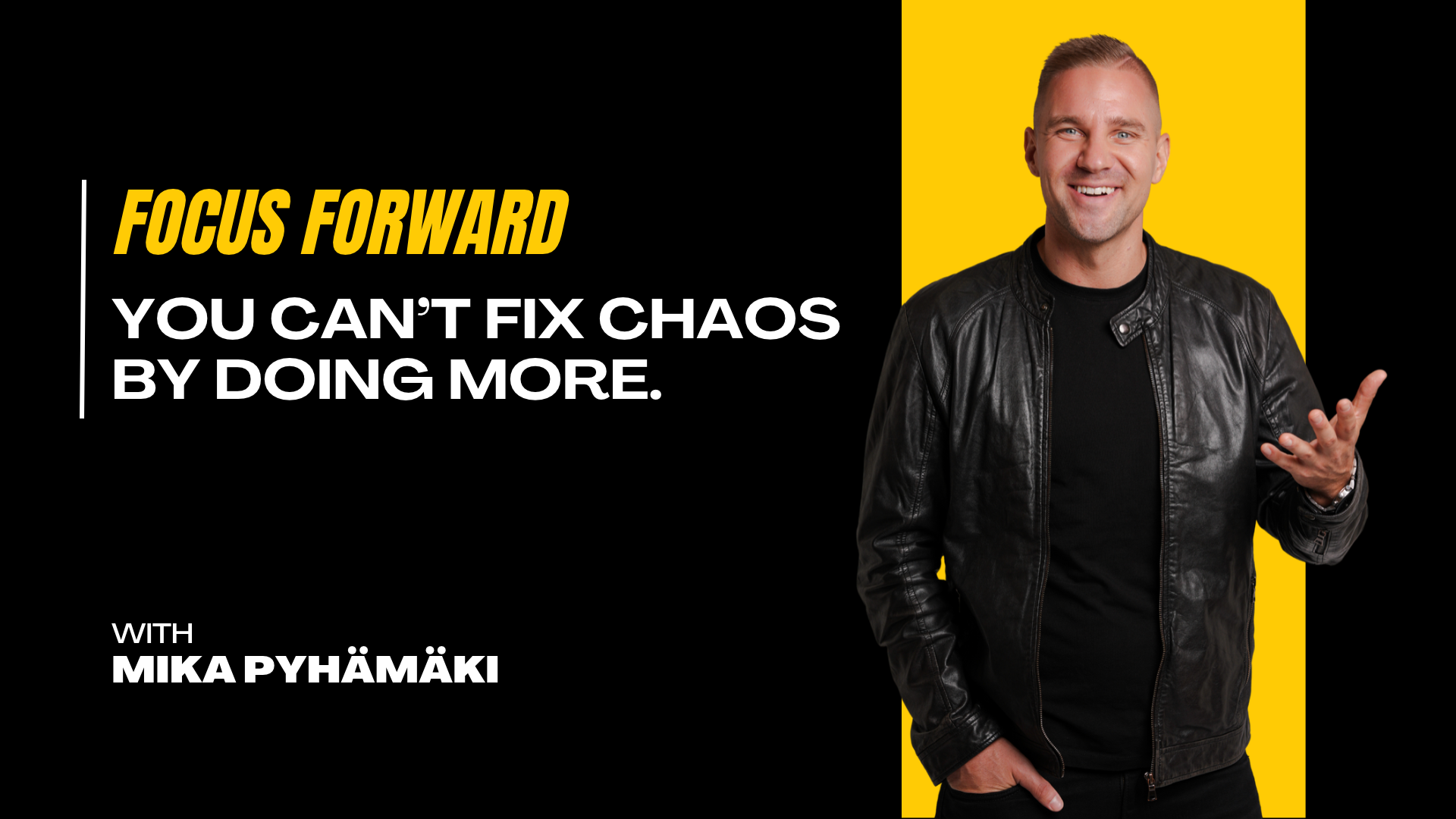
You can't fix chaos by doing more. You fix it by doing the right things, again and again.
Did you enjoy this article?